


As the Australian Open kicked off last week, there was a note of despair in some corners of the squash community. “Have you seen the draws?” Bill Buckingham of Squash Radio asked co-host Paul Johnson. “They’re so poor.” The sentiment was understandable, if unkind to the players who’d showed up for the event. Only two of the top 10 female players and three of the top 10 men would feature in the tournament. No Sherbini, no Hammamy, no Asal or Gawad or Elias. Given the growing number of tournaments on the tour, and the brutal travel and acclimation to the southern hemisphere, why prioritize a far-flung and lower-tiered event?
But there was good reason to lament: the Australian Open this year, held outdoors in the stunning amphitheater in South Bank Piazza in Brisbane, was to be a showcase to the International Olympic Committee. Before 2026 is up, the IOC will announce which sports will be included in the 2032 Summer Olympics—also held in Brisbane. This was a chance for squash to impress, to wow. According to Johnson, the PSA—an organization hardly flush with funds—had prioritized broadcast potential over all else. All the bells and whistles of a Platinum event were on display: a fetching glass show court, an overhead cable cam, super slow-motion and gimbal rigs, dedicated replay cams for line-call reviews, and the PSA desk with Michael Absalom as host, along with Lisa Aitken and Jenny Duncalf in commentary.
That reasoning might have resonated more powerfully had all the bells and whistles offered a seamless affair—which they didn’t quite. In the women’s quarter-final between Marina Stefanoni and Salma Hany, at match point in the fourth game—Hany up 10-9—the Egyptian hit a ball that looked out of bounds. She went on to win the point and the ref called game. Stefanoni pointed up to the line. “I saw the ball good,” the ref said. During the break, the replay showed otherwise. This kind of error would be problematic in any case, but at match ball in a closely contested battle, with members of the IOC watching, it’s embarrassing. What’s the point of spiffy cameras when you have an outdated rule that states “players cannot request reviews for line calls”?
This is not an isolated failure. With a spate of recent poor double-bounce and line-calls, and baffling no let and stroke decisions of which Brisbane was not immune, it’s become apparent the nature of these failures extends beyond squash's inherent officiating challenges. Johnson, asked by Buckingham whether viewers should hear central referee-VR conversations as in rugby, was blunt: “I don’t want to berate the refs, I’m a massive fan of the refs…but if you were to hear some of the conversations that go on between the referee and the VR [about their] decisions…I’m going to be honest, they’re horrendous.” It’s no secret squash has a referee shortage; experienced refs are working hard training new ones, but the new ones are still pretty green. Give them some grace—but I’d swap the overhead cam and the occasional Michael Absalom (charming though he is!) any day for a more robust investment in referee training, recruitment, and compensation. Get the house in order. Then decorate.
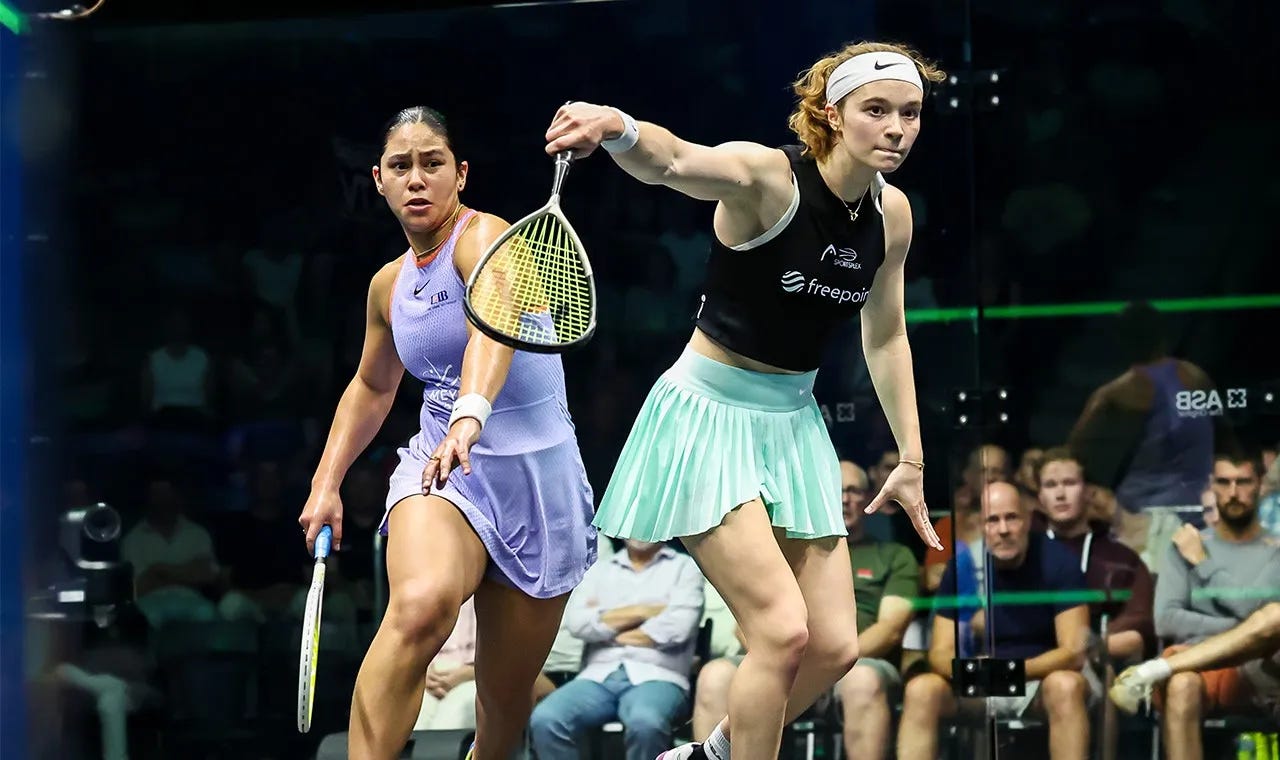
And yet—despite all that—the Australian Open was something to see, and more to the point, something to show. For starters, there was Stefanoni, who even after that poor call in the fourth ended up the deserved victor after a tense five games with Hany. Just 23 years old, Stefanoni has only recently joined the tour full-time, having graduated from Harvard in 2024 with a BA in Astrophysics and Economics. (Honestly, the number of pro squash players who’ve come out of Harvard is a little obscene.) She has a penchant for burgers and self-deprecating humor, often in the same breath. (“Hopefully I win today so everybody’s not like, ‘haha, she lost because she had a burger,’” she said in a recent pre-match interview.) On court, the affability disappears. She keeps her head down and rarely gets flustered. You’ll often see her hopping around players to execute a deft drop shot, where others might have stopped for a let. Her boast is killer. For all that flair, the crowd in Australia, from the quarter-finals on, was cheering for her.
“You had some fantastic support from the local crowd,” commentator Paul Hornsby said to her after her battle against Hany.
Stefanoni smiled. “I don’t know who those people were, but they were amazing.”
The next day, she took down Tinne Gilis 3-1, beating the Belgian for the first time and reaching her first ever Gold event final. You could miss the top players—and surely there were times I did—but had Hammamy or El Sherbini been there, we almost certainly wouldn’t have gotten to see the likes of Stefanoni, an underdog, rise through the ranks. That’s a story well worth following, too—and I for one was happy to take a break (just a little one) from the often unbearably tense matchups of the top four. Moreover, Stefanoni’s ascension highlighted the strength of the U.S. players. Right now, there are four Americans in the top 20. (Stefanoni now sits at a career high of #15.) Only Egypt has more than that.
If Stefanoni’s win against Gilis arrived as an exciting milestone, it was a mere appetizer for what came next: an epic, five-game clash between Mohamad Zakaria and Joel Makin—two players whose match-ups are increasingly becoming absolute must-sees, not least for the new, unexpected mutual respect that has blossomed between the players.
Zakaria, the World Junior Champion, has been a controversial subject this season. An undeniable talent—his line hitting is second-to-none—he also has a history of more than a few dodgy movements. The Qatar Classic last fall was a breaking point, where at the very end of a closely contested match against Jonah Bryant, the Englishman was awarded three strokes after Zakaria repeatedly blocked his path to the ball. Shortly thereafter, in an interview on SquashTV, Zakaria was contrite: “I’m ashamed with myself with the movement I was doing. That’s not how I want to play.” Those of us troubled by his conduct—here I raise my hand—were optimistic, if cautiously so. Saying change is coming is one thing; it’s another to back it up in action. But it was at least heartening to hear the 18-year-old level with us—and himself. (It’s nearly impossible to imagine a certain World No. 1 showing the same maturity, but I digress.)
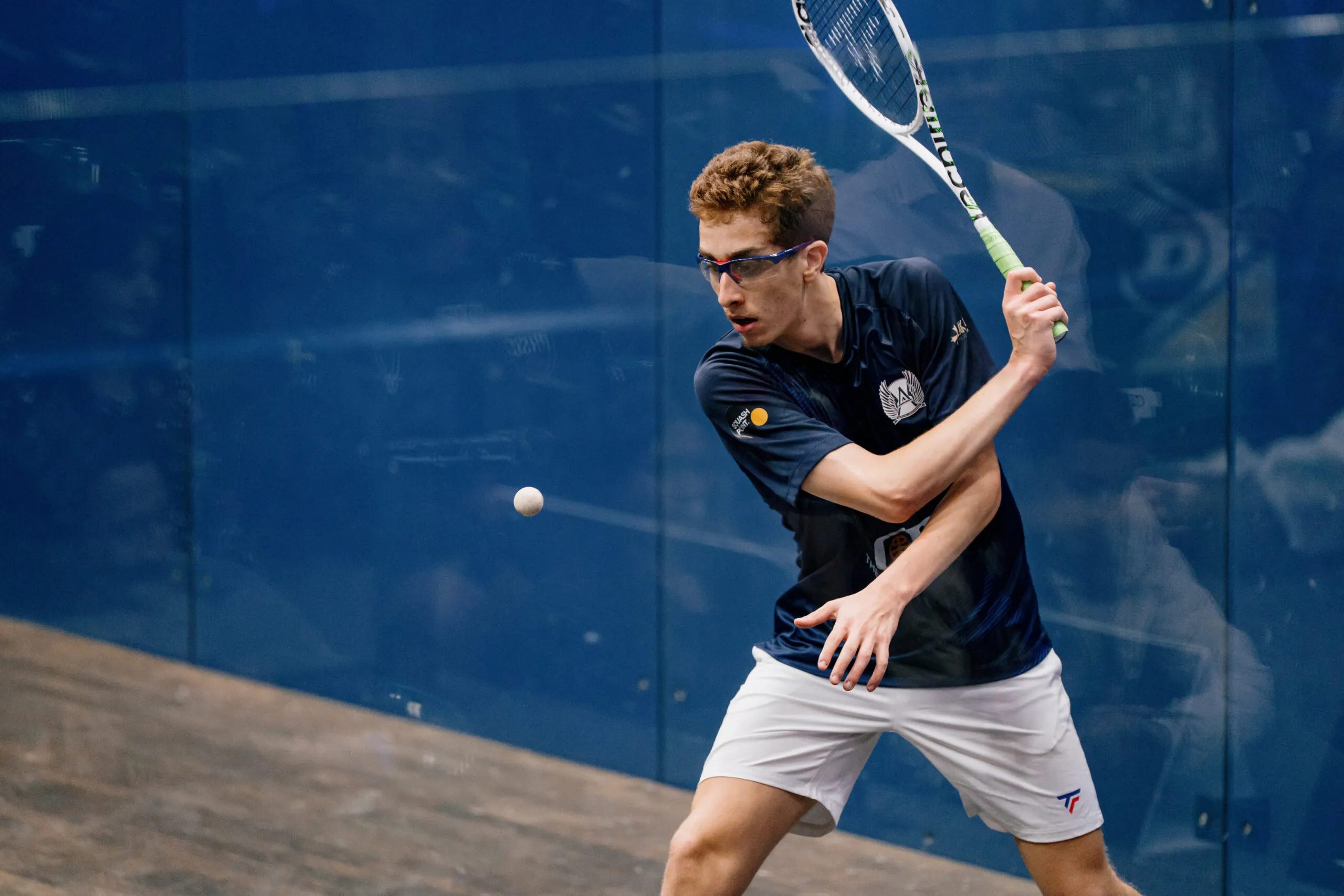
In the months since Qatar, results have been inconclusive. Yes, Zakaria had cleaned up some of his more egregious movements. But there were moments at the U.S. and Karachi Opens, and at the ToC, when not clearing, or indeed blocking, looked to be back in play.
Not down under. A week before the Australian Open, Zakaria met Makin at the New Zealand Open—only their second match-up on the PSA tour—and the result was one of the best men’s matches so far this season. A whopping 125 minutes of pure squash, largely free of decisions. Zakaria won in a tie-break, and as Makin congratulated the Egyptian, he put his hand on his arm and said a few words the mic couldn’t pick up. According to Jenny Duncalf, Makin apparently said, or roughly said: “That was a great match, why don’t you play like that all the time?”
In Brisbane, it was refreshing to see Zakaria take Makin’s advice to heart. In another five-game thriller, Zakaria played cleanly. If there were a couple of instances of slow clearance, you’d have to chalk it up to exhaustion; his quarter-final match against Malaysia’s Eain Yow Ng the day before had been a testing affair. Multiple times during his match with Makin, Zakaria bent over double, winded—which only made his performance all the more remarkable. Watching him, I was reminded of El Sherbini, who often finds a scary level of accuracy when injured. Zakaria, in the fourth game, essentially hobbling around the court, wincing with cramp pain, overcame a deficit with immaculate line hitting and lobs to take the match into a fifth. Makin prevailed, by a hair, winning the game 11-8.
The final point of the match is worth lingering on, showing as it did another layer of Zakaria’s growth. At match ball, Makin dived to return a drop shot, leaving a huge sweat patch on the ground—on which Zakaria, lunging for the ball, slipped and fell to the ground. Most anyone would have asked for a let, and surely Zakaria was entitled to one. Instead, the young Egyptian smiled and offered his hand to Makin. He knew he was beat. And maybe, too, he knew that he had nothing left in the tank for a final.
“The kid’s talented,” Makin said in his post-match interview. “Gutsy. You don’t get many 18-year-olds playing at that sort of level. Maturity. He’s only going to get stronger. I enjoyed it. Doesn’t get any better than that in front of a big crowd, it was great fun.”
So, too, was the final, between Makin and Paul Coll. The first game, which ran 44 minutes, was a match in and of itself—longer, in fact, than the entire women’s final (an admittedly anti-climactic affair, Malaysia’s Sivasangari Subramaniam proving a bridge too far for Stefanoni). During the lengthy and breathless tie-break, Makin and Coll traded several game balls, Coll finally squeaking out the win 19-17. But the entire 90 minutes was a thrill—enough so that the occasional questionable decision quickly fled from mind. It was hard to imagine anyone having a moment to miss the World No. 1. Indeed, the quality and suspense of the match only threw into relief—at least for me—just how dull the dominance of Mostafa Asal has become this season.
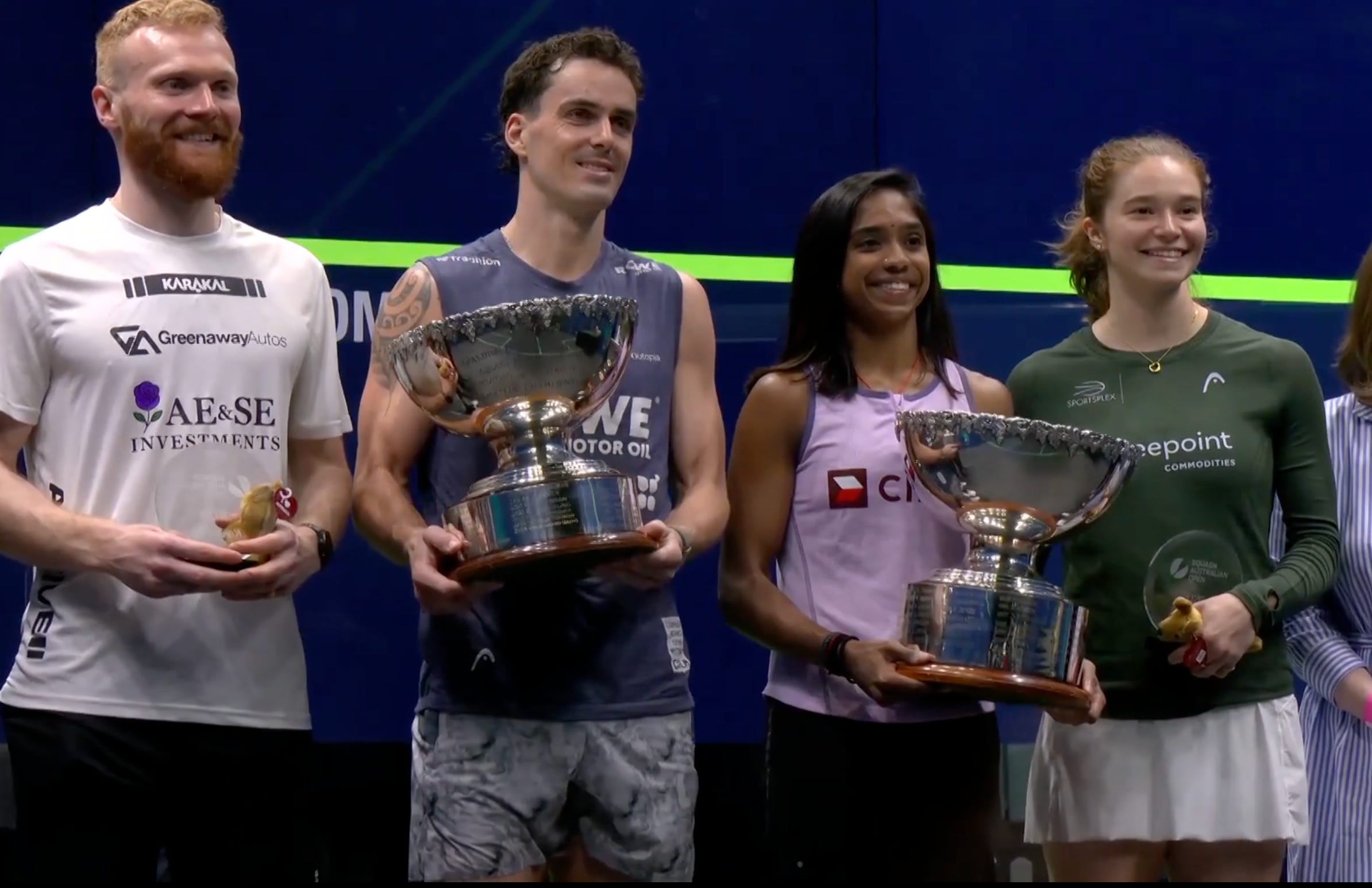
And so, the Australian Open ended on a high, a worthy display to the IOC—pure squash all week, played in good spirit, that managed to overshadow the sport’s rougher edges. It occurred to me, too, as the four finalists took to the stage for the closing ceremony, that here was a rare sight. Most finals are Egyptian-heavy; many are all Egyptian affairs. But in Australia, it was Malaysia vs. the U.S., and New Zealand vs. Wales. That may not be a representation of the cream of the crop, but as an advertisement for a sport in the Olympic spotlight, you couldn't do much better.
Thank you for this. There seems to be zero squash writing anywhere, let alone thoughtful, well-expressed pieces. There is rich material in the athleticism and drama of the best matches