

Shotmakers
Satomi Watanabe and Youssef Ibrahim Find Electrifying Form in China

Since November 7, when Japanese Prime Minister Sanae Takaichi indicated that Tokyo would support Taiwan militarily if seriously threatened by Beijing, tensions between the two countries have been running high. In China, youth exchange programs have been frozen, Japanese film premieres cancelled, plus dozens of concerts featuring Japanese singers—the reasons cited: ‘unforeseen circumstances’ or ‘force majeure’.
All of which made the scene at the China Open in Shanghai heartening—a packed crowd, predominantly Chinese, cheering for Satomi Watanabe as she took down World #1 Hania El Hammamy.
“I honestly can’t believe it,” Watanabe said after her win.
It was a near universal sentiment. Until that moment, El Hammamy had been undefeated this season, and before the China Open I don’t think anyone would’ve guessed it would be Watanabe to break her streak. The Japanese player has never taken a match off the Egyptian, and moreover, she’s had a rocky start to the season. At the Egyptian Open this fall she was knocked out in round 3 by Fayrouz Aboelkheir, and a few weeks later in round 1 by Aria Azman at the Qatar Classic—a major upset. Speculation ran that, after an extraordinary run last year, the pressure of reaching a career high ranking (#6) and being the highest ranked Japanese player ever had begun to heavily weigh on her. She seemed joyless and unfocused on court.
Moreover, she’s not had a consistent presence in her corner at tournaments. Between games, she’d often sit alone, not even consulting the handwritten notes she’s known to cradle in her lap. At the U.S. Open, Rachel Arnold and Jasmine Hutton could be seen coaching her between games, and while it’s always nice to see competitors coaching each other, I wondered if she needed more veteran guidance, perhaps from former World #3 Allison Waters, with whom Watanabe trains in London.
But at both the China and Hong Kong Open, Taiki Kaido was at her side. Kaido, a squash player himself, is Watanabe’s Japanese coach, and her fiancé. Each time the camera settled on Kaido watching Watanabe play, he wore a placid smile no matter where Watanabe was on the scoreline. Between games, he walked unhurriedly alongside her back to her corner, the essence of calmness. Whether it was Kaido’s guidance, or simply Watanabe settling into the season—I suspect it was a bit of both—by the quarter finals in Shanghai, where Watanabe took down the dangerous Sana Ibrahim 3-0, it was clear she was rising from her slumber.
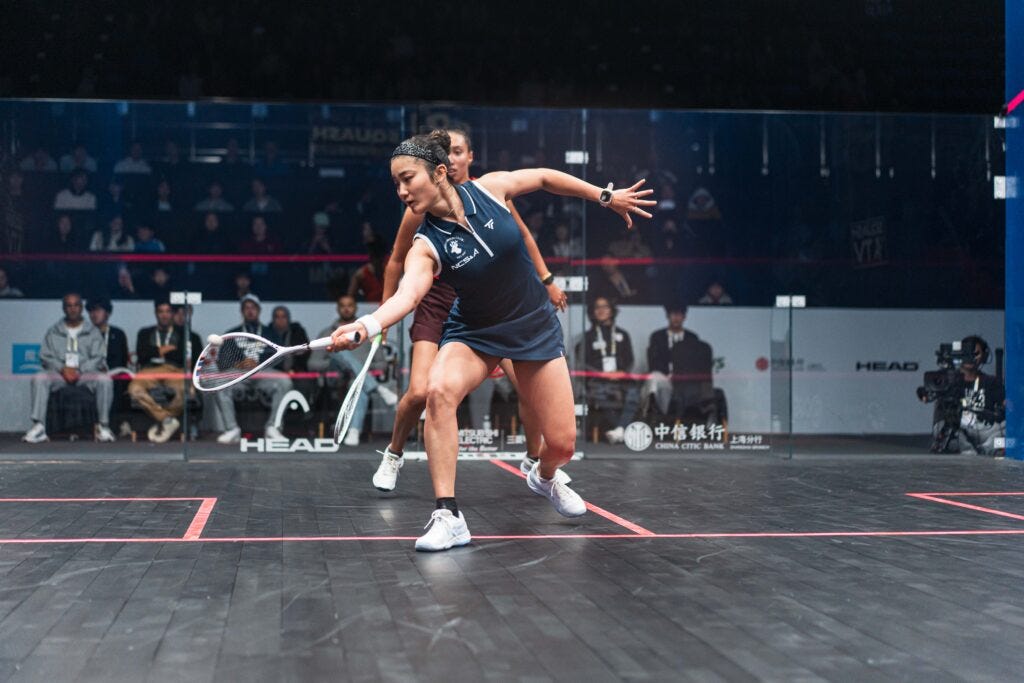
But taking down El Hammamy was another question entirely.
Watanabe is an excellent shotmaker—her cross-court drives and kill shots down the side walls are exhilarating to behold—but what was most impressive in her semi-final against the World #1 was a newfound patience. Watching her dominate was to be reminded of Paul Johnson’s term for Squash: “chess on legs.” In squash as in chess, it often behooves the players to proceed with caution and wait for the other to make a mistake—a tactic that Watanabe, an aggressive player, does not often employ. She did against El Hammamy to masterful effect, lobbing the ball to the back corners, waiting for the Egyptian to play a loose ball or slam the ball into the tin—or just below it—which El Hammamy did several times, including at match ball.
Watanabe lost in the final to Amina Orfi—a formidable opponent not prone to errors—but she would get her revenge not three weeks later at the Hong Kong Open, taking Orfi down 3-2 and playing her best squash all season in the decider. It was another, notable victory: not only did it place Watanabe in her first ever Platinum semi-final, it also distinguished her as the only player this season to best the two top Egyptians currently on tour.
That’s a fact worth keeping in mind even as she lost out to Olivia Weaver in the semis. “Watanabe’s got ridiculous talent,” Jenny Duncalf said in the commentary box during the first game, “and that’s why she’s got wins over the top two players in the world. The question has always been: can she do that every time she steps on court, within reason.”
If the answer was no in the semis—her error count was high, despite a near perfect second game, which she took 11-6—her overall performance in China gives one hope. And it’s worth noting that her win against Orfi the night before was not only physically arduous, it was, by Watanabe’s own admission, emotionally taxing, thanks to a series of harsh no let calls. Just as it’s worth noting that Weaver, an extraordinary player, has proven consistently shaky against the top Egyptians. She’s lost to Orfi in their last two meetings and has never beaten El Hammamy on tour, nor El Sherbini in their 16 matches, the Hong Kong final marking their latest, a decisive clash.
For now, as the first part of the season wraps up, it’s Watanabe, back at World #6, who has the clearest path towards upsetting the players at the very top.
On the men’s tour, Youssef Ibrahim has also reached a career high ranking of World #6. Like Watanabe, that’s a success borne of finding a more disciplined game—a balance between attritional rallies and sudden explosive attacks. They don’t call him the gunslinger for nothing.
“I’ve been working for so many years trying to find the right balance,” he said after beating Miguel Rodríguez in the quarter finals in Hong Kong, a fantastically entertaining match.
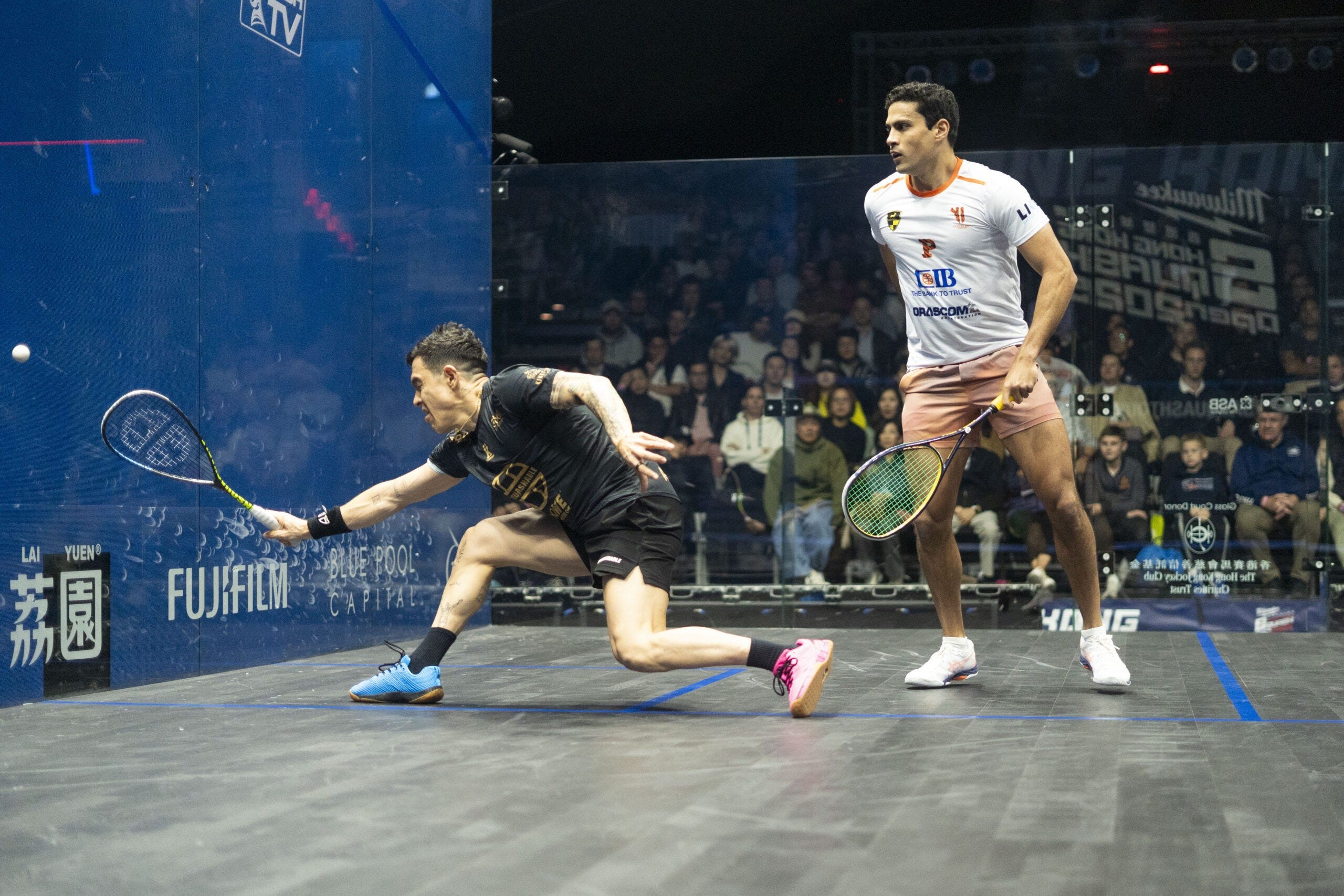
Then again, any match featuring Ibrahim is bound to entertain. He can be, at times, comically good, instigating fast-paced rallies with rapid volleying before trapping his opponent behind him—all but stopping play—and giving the ball the lightest tap into a front corner, as if absently swatting away a fly. The crowds in China are among the most expressive and joyful on the pro tour, and through the tournaments they could be relied on to ooh and ahh, especially for Ibrahim. He’s among the players most likely to attract new viewers to the game, a fact to which I can personally attest. My wife, not a squash fan, has never made it through a game—until she sat down to watch Ibrahim. “Wow,” she said, after one of his signature slams into the nick. (A moment later she added, “I mean, it doesn’t hurt that he’s very attractive.”)
In China, he reached the final at every event—the China, HKFC Squash, and the Hong Kong Opens. He came up short each time, though at the China Open, only just, losing to Mohamed Abouelghar in the fifth game 12-14. No matter who you were rooting for, it was a breathless, inspiring showdown. In a season at times hampered by poor sportsmanship and harsh refereeing, matches with Ibrahim are consistently clean. That’s partly owed to his opponents (Abouelghar and Rodríguez, for instance, are wonderfully fair players), but more so to Ibrahim’s mode of playing—constantly working his opponent off the T, into the back, into the front, he all but forces fair play.
And so it was in the final against Mostafa Asal in Hong Kong, a game largely devoid of stoppages. Ibrahim lost 0-3, but two of those games were close, filled with thrilling rallies. During the third game, you could hear Joey Barrington in the commentary box lamenting the absence of Diego Elias and Joel Makin.
“Unfortunately, the players that can really test [Asal] are injured.”
Give Ibrahim a minute. Like Watanabe, the question of consistency has swirled around him for a while. But the thing about consistency is that it’s a problem until it isn’t. Before China, Ibrahim had consistently lost to Paul Coll, the World #2—and then over the past three weeks he beat him two matches in a row, with relative ease.
In the fall, Ibrahim said he wanted to break into the top 3 by the end of the season. In Hong Kong, he said he wasn’t thinking about that. “I’m just playing and enjoying it, trying to challenge the best players in the world, and hopefully by the end of the season, if I stay consistent enough, I can achieve my goal.”
I’d bet on it.